Real Estate Market Forecast for 2026 - Is It a Good Time to Buy or Sell?
Buying or selling property is a decision with significant financial consequences. In 2026, Poland's real estate market enters a new phase: after dynamic movements in recent years, we observe price stabilization, changing role of credit costs, improved market visibility, and gradual monetary policy easing. In this article, I'll analyze key factors influencing the market in 2026, explain who should buy versus sell, and propose specific strategies and checklists.
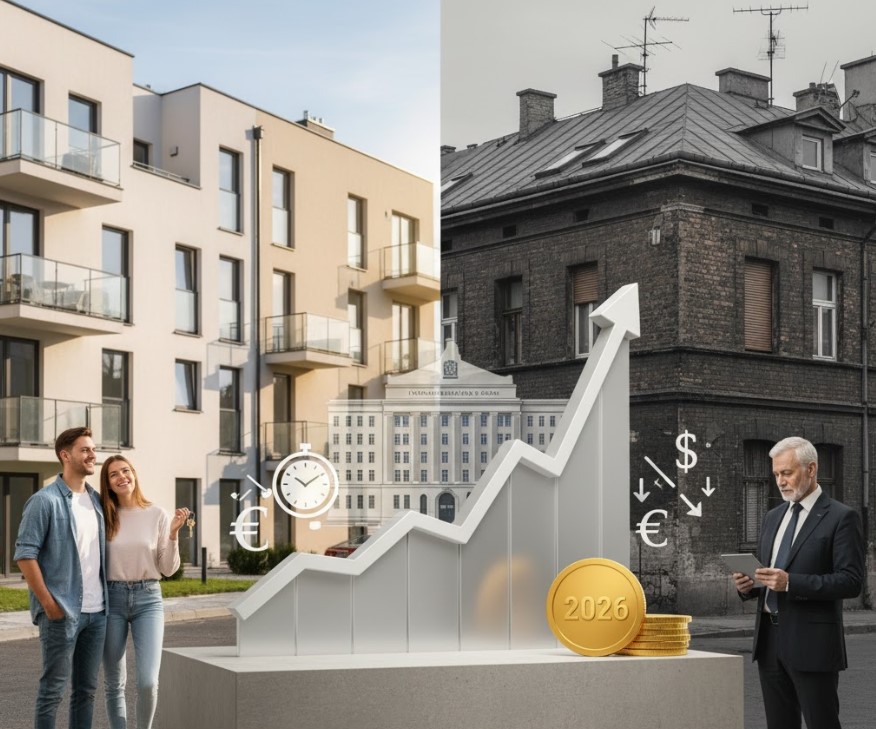
1. Brief Situation Summary (End of 2025 / 2026 Forecasts)
-
Price Stabilization: After several periods of strong growth in 2021-2024, Poland's housing market is entering a stabilization phase, with slight increases in the primary market and moderate transaction dynamics. GUS and BaRN data indicate growth in 2025, but at a much slower pace than during the boom phase.
-
Interest Rates and Monetary Policy: NBP forecasts gradual inflation decline in 2026 and gradual interest rate reductions compared to 2024-2025 levels, though the pace of cuts will remain moderate and conditional. This means mortgage costs may partially decrease in 2026, but won't immediately return to pre-rate-hike levels.
-
Supply and Demand: Supply of new apartments is limited by construction costs and planning procedures, but demand is slowly growing due to improved confidence and a more stable economy. Developers report cautious approaches to launching new projects.
-
Analyst Forecasts: Major banks and analytical houses (PKO BP, NBP) forecast moderate price increases in the first half of 2026; other analyses warn of possible corrections in some segments (e.g., "geographic declines" outside major cities).
2. Key Market Forces in 2026 (What You Need to Monitor)
Below I discuss macro and market factors that will likely determine market direction in 2026.
a) Monetary Policy and Interest Rates
Mortgage costs are among the most important factors influencing demand. If NBP (and markets) interpret inflation as sustainably approaching target and GDP doesn't encounter sharp slowdown, rates will begin to fall - but the pace will be gradual. Rate declines in 2026 mean greater purchasing power and increased demand, which could push prices up. However, the market has already "priced in" some expectations, so effects may be better for those refinancing than for new buyers.
b) Inflation and Real Income
When inflation falls, real income stops being "eaten away," improving credit capacity and purchase willingness. NBP expects inflation to decline in 2026 (projections show decline to around 3-3.5% earlier, with further decline in subsequent years). This creates favorable conditions for demand, especially if real wages grow moderately.
c) Construction Costs and Land Availability
Material and labor costs, plus procedures (local zoning plans, permits) affect supply of new apartments. If construction costs remain high, developers will limit new projects, supporting prices of existing apartments. Conversely, if costs fall, supply will increase and this could dampen price pressure.
d) Housing Policy and Government Support
Instruments like subsidy programs, tax relief, or social housing facilitation are significant. Lack of clear, large support programs (like previous subsidies or cheaper loans for young people) weakens investment demand, though local initiatives can support the market.
e) Investor Sentiment and Foreign Activity
Institutional investors, real estate funds, and foreign capital react quickly to rate changes and macroeconomic conditions. If Poland is perceived as a stable location with growth perspective (e.g., regional development, controlled inflation), capital inflow to the PRS (Private Rented Sector) segment may grow, affecting rental markets and prices.
3. Who Should Buy in 2026? (When to Purchase)
For some groups, buying in 2026 will make sense - when specific conditions are met. Here's who should consider purchasing:
A. Long-term Buyers (Homebuyers)
If you plan to live in the property for 7-10 years (or longer), 2026 could be a good time, provided that:
- You have stable financing or savings
- You compare loan offers (possible rate declines in 2026 will improve conditions)
- You buy in locations with good fundamentals (major cities, areas with strong job markets)
For long-term users, short-term price volatility is less important. The key is finding an apartment that meets needs and provides living comfort.
B. Those Refinancing or Waiting for Rate Drops
If you observe prospects for rate declines in 2026, you can benefit from refinancing or taking loans at more favorable times. For those who can temporarily wait with decisions, monetary policy easing may provide opportunities for better conditions.
C. Long-horizon Investors (Rental)
In areas with stable rental demand (major cities, university centers), buying apartments for rent still makes sense - especially if cash-flow calculations work favorably after considering loan costs. In 2026, increased rental demand is possible (workforce mobility, young people preferences), supporting rental markets.
4. Who Should Sell in 2026? (When to Sell)
Selling can also be optimal in 2026 - but depends on goals and segment.
A. Short- and Medium-term Investors (Flipping)
If your strategy is quick post-renovation sales (flipping) and local markets show high turnover and demand - opportunities can still be found. However, in 2026 margins will be smaller than during the boom, requiring careful cost calculation and demand stagnation risk assessment.
B. Property Owners in Weaker Locations
If you own apartments outside main cities, in areas where demand is declining or stagnating (e.g., unattractive districts), selling in 2026 could be a good move before potential local corrections reduce value.
C. Highly Leveraged Owners Wanting to Reduce Risk
If your property portfolio is highly leveraged (high LTV) and you're concerned about rate fluctuations or lower liquidity, selling in good locations now can reduce risk. Better to sell part of the portfolio with stable demand than risk forced sales later.
5. Market Segmentation 2026 - Where to Expect Growth vs Corrections
1) Major Cities (Warsaw, Krakow, Wroclaw, Poznan, Tri-City)
- Opportunity: stable demand, relative protection against declines; premium segment and well-located apartments maintain value
- Risk: market already relatively "priced"; valuation depends on new project supply and developer costs
2) Local Markets and Smaller Cities
- Opportunity: low entry prices - possibility to buy at discount
- Risk: smaller rental markets, lower liquidity - greater risk of longer holding periods
3) Office and Retail Segments
- Opportunity: Class A rental stabilization in major cities; repurposing unattractive spaces
- Risk: hybrid work models continue affecting office demand; retail depends on local demand strength
4) Land Plots and Land Investments
- Opportunity: limited supply of building plots; land value in development zones may increase
- Risk: planning risk (local zoning plans), land development costs
6. Calculation: Buy Now or Wait? - Simple Scenarios
Below are three simplified scenarios to help assess decisions (indicative numbers - each transaction requires own calculations).
Scenario A - Long-term User (5-10 years)
- If planning to stay in property 7+ years → buy if loan conditions are acceptable and location fits. Long-term, inflation and regional development can boost real property value.
Scenario B - Buy-to-let Investor with Loan
- Check cash-flow: gross rent - costs (renovation, taxes, insurance, installments) > 0. If positive cash-flow or acceptable return rate (e.g., 3-5% net) is possible at current and forecasted rates → consider purchase. Otherwise, better to wait for rate drops.
Scenario C - Short-term Investor/Flipper
- Margin must cover capital and renovation costs. With price stabilization (2026), margins will be tight → only projects with clear added value (renovation + location) are profitable.
7. Practical Recommendations - Checklists for Buyers and Sellers
For Buyers (Pre-purchase Steps)
- Calculate credit capacity and compare offers (differences in interest rates and fees matter)
- Check total costs: not just price, but also taxes, notary, fees, renovation, maintenance
- Conduct local market analysis: number of offers, average sales time, rental levels
- Verify legal status: land register, encumbrances, easements, zoning plans
- Negotiate settlement method (deadlines, final conditions)
- Secure financing - consider fixed/variable installments and refinancing options
For Sellers (How to Maximize Price)
- Focus on presentation: small investments in home staging often pay off
- Set realistic asking price - analyze comparable transactions
- Consider rental option as alternative - stable income can be solution if market is difficult
- Plan timing: sell before low activity season, or when local market appears "hot"
- Prepare complete documentation - transaction speed increases buyer confidence
8. Risks and Worst-case Scenarios (What Could Go Wrong in 2026)
- Unexpected economic downturn (e.g., European recession) → demand decline and price correction
- Prolonged high interest rates longer than expected → frozen demand
- Political decisions (e.g., sudden tax or regulatory changes) → reduced liquidity
- Local corrections: markets outside major cities may experience larger declines
9. Practical Strategies for Different Roles (Developer, Investor, Agent, Buyer)
Developers
- Conservative stage launches: start with fewer apartments and flexible completion dates
- Cost control: renegotiate scopes and deadlines with subcontractors
- Demand-matched product: greater interest in compact and flexible spaces
Institutional Investors
- Seeking stable cash-flow (PRS segment, senior living)
- Interest rate hedging: rate protection in contracts
Real Estate Agents
- Client education: explain impact of rates and inflation on decisions
- Local marketing: show comparative data and sales times
Individual Buyers
- Buy with safety margin (savings, buffer for unexpected expenses)
- Negotiate loan terms and consider fixed rates if anticipating short-term rate increases
10. Conclusions - Buy or Sell in 2026?
In summary:
- For long-term users (years of residence) 2026 is a good time to buy, especially with stable financing and purchases in good locations. Inflation decline and possible rate easing should gradually reduce loan costs.
- For short-term investors (flipping) 2026 will require greater caution; margins will be smaller than during boom, so selection and cost control matter.
- For sellers: if you have property in weaker locations and want to minimize risk, consider selling now; but if you have property in top locations, you might wait for improved credit conditions (which could boost demand).
Overall - 2026 is rather a period of stabilization and selective opportunities than dramatic declines or growth peaks. Location, property quality, and financing structure will be crucial.
11. Brief Q&A (Frequently Asked Questions)
Will apartment prices fall in 2026?
Rather stabilization with possible moderate increases in major cities; declines possible locally.
Is it worth buying apartments for rental?
If cash-flow is positive (after considering installments, costs and taxes) and location has stable rental demand - yes. For better returns, long-term price growth also matters.
When to expect interest rate drops?
2025-2026 forecasts suggest gradual reductions, probably from second half 2025/2026, but pace and timing depend on inflation and international situation.
12. What to Do Now - 6 Practical Steps
- Make realistic calculations: calculate total purchase cost (installments, taxes, fees, renovation)
- Local analysis: check comparable transactions and average sales time in area
- Compare loans: plan variants (fixed vs variable installments)
- Establish exit plan: if investing, have plan for longer asset holding
- Secure liquidity: don't invest all savings - leave buffer
- Use experts: notary, loan advisor, agent - especially for higher-risk investments
13. Sources and Further Reading (Selected Materials and Reports)
- Apartment price information and market situation - NBP (BaRN)
- Monetary policy assumptions for 2026 - NBP
- Inflation and GDP projection (July 2025) - NBP
- Residential property price indicators (GUS) - Q1/Q2 2025
- Analytical articles and forecasts (PKO BP, Business Insider)
- Media commentary and news about rates - Reuters
14. Conclusion - Practical Message in Three Sentences
2026 is a year of opportunities for those with long-term horizons, caution for short-term speculators, and necessity of selection for investors. Location, financing, and realistic profitability calculations will be crucial. Monitor interest rates, inflation, and local price indicators - they will determine short-term market direction.
15. WawelDom Real Estate - Your Partner in 2026 Investment Decisions
In such a complex and dynamic market as Poland's real estate, reliable analysis, experience, and local knowledge play a key role.
This is where WawelDom Real Estate comes in - an agency that for years has supported investors, developers, and private individuals in safely making decisions regarding property purchase, sale, and rental.
WawelDom combines market analyst competencies, investment advisors, and agents. Thanks to this, clients receive not just offers but full support - from profitability analysis, through financing assistance, to transaction finalization.
In 2026, when the market requires increasingly precise decisions, WawelDom focuses on:
- local price and trend analyses - particularly in Malopolska region and southern Poland
- premium and investment property service
- land sale and development investment advisory
- tax and financial optimization strategies for transactions
- SEO and social media-based property marketing, increasing offer reach and number of real clients
The WawelDom team consists of experienced agents, appraisers, market analysts, and marketing specialists. Each investment is treated individually - with emphasis on maximizing property value and minimizing risk.
WawelDom is not just a real estate agency - it's an investment partner that helps:
- individual investors find apartments with growth potential
- developers select best land and develop sales strategies
- owners effectively sell properties using modern marketing tools
- private clients safely buy dream apartments or houses
Thanks to years of experience and local market knowledge, WawelDom has gained reputation as a brand that combines professionalism with human approach - advises, explains, analyzes, and guides clients step by step through every process stage.
In a world where information changes faster than portal offers, it's worth having experts who think long-term and strategically on your side.
Therefore, if you're considering property purchase, sale, or investment in 2026, contact WawelDom - the team that will help you turn decisions into success.
www.waweldom.pl
Investment Advisory • Property Sales and Purchase • Market Analysis and Marketing