Mission: House 2026
How to build cheap, well and not go bankrupt? A compendium for a 2+2 family (90–110 sqm)
Author: Your Personal Expert Journalist • Lawyer • Architect • Builder February 2026
Introduction: Construction landscape of 2026
Journalist Economic journalist’s perspective
Building a house in 2026 is a game on a completely different board than five years ago. The era of crazy material price increases (2021–2023) is behind us – material inflation has slowed down, and prices are stabilizing, albeit at a high, “new normal” level. What has irreversibly become more expensive? Labor. A specialist who took PLN 35 per square meter of plaster in 2020 now demands PLN 70–80 for the same work, and sets the deadline six months ahead. We are entering an era where “cheap” no longer means “shoddy”, but “smart and compact”.
The European Union is tightening the screws. The EPBD directive (emission-free buildings) is slowly becoming a Polish reality. From 2026, every new building must be designed with nearly zero energy consumption in mind, and banks are increasingly rewarding “green loans” with lower margins. For a family with two children (2+2 model), the goal is clear: we are not building a monument. We are building a living machine. Functional, cheap to run and, crucially, financeable without years of belt-tightening.
STAGE 1: Land and formalities – the foundation for low costs
Lawyer Architect Lawyer & Architect point of view
Legal pitfalls when buying land
Before you fall in love with a forest view, I have to throw a bucket of cold water on you. In 2026, a “cheap plot” is usually synonymous with “expensive problems”. I have represented clients who bought a seemingly bargain land with access via a “path” that turned out to be the neighbour’s private property. The cost of establishing an easement – PLN 25k, and no one counts the nerves.
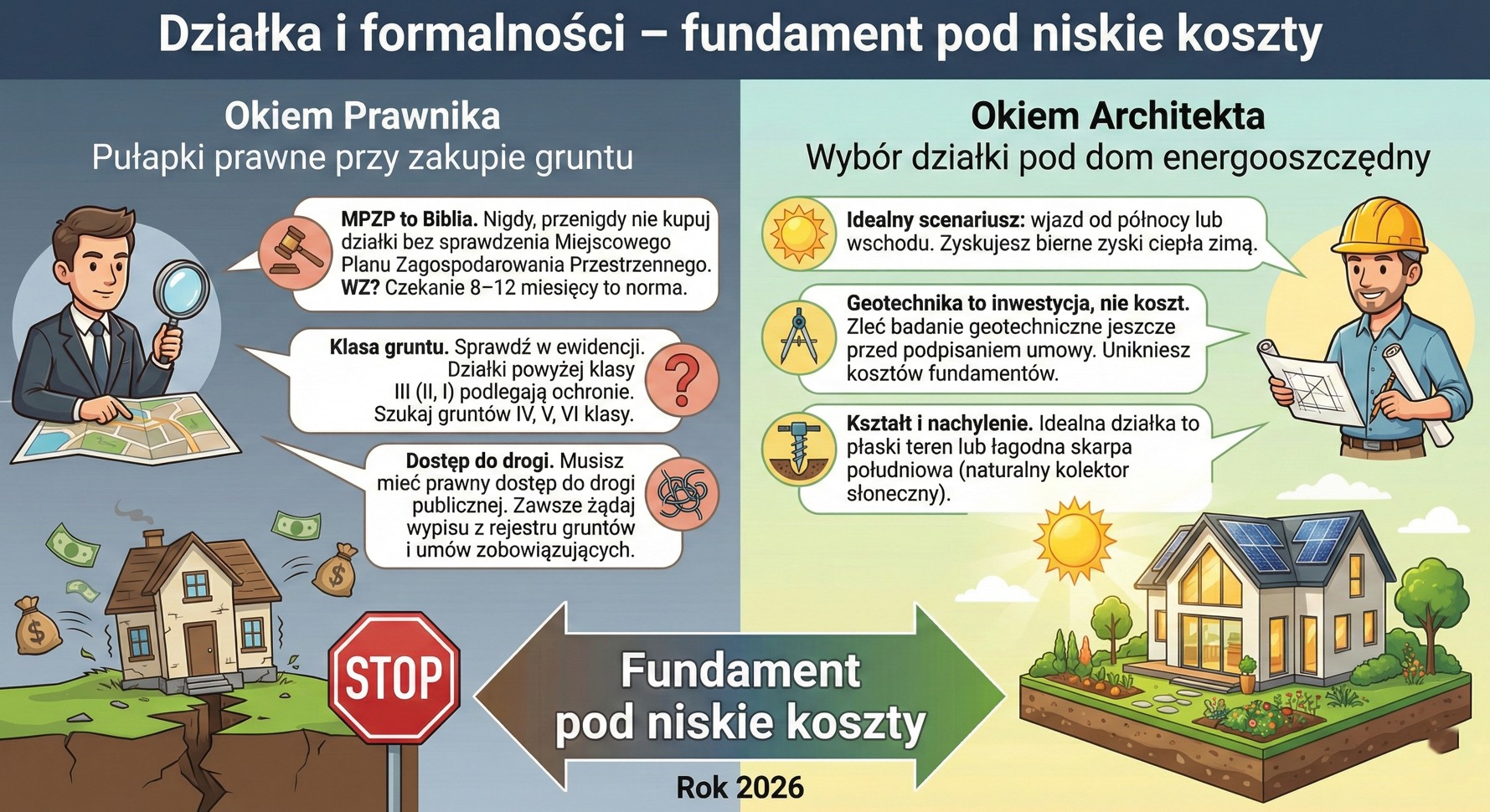
MPZP is the Bible. Never, ever buy a plot without checking the Local Spatial Development Plan. If it doesn't exist, you are subject to Development Conditions (WZ). In 2026, the WZ procedure is even slower than before – municipalities are preparing General Plans (act of 2023) and often suspend decisions while these documents are being drafted. Waiting 8–12 months for WZ is now the norm. And time is money – rising labor costs and variable interest rates.
Land class. Check the land quality class in the land register. Plots above class III (II, I) are protected. Declassification of agricultural land is legally permissible only in special cases (no other land in the municipality) and costs a fortune – one‑time and annual fees can reach PLN 100–200k. Look for class IV, V, VI land. The lower the class, the fewer formalities.
Road access. It cannot be a “path trodden by a neighbour”. You must have legal access to a public road – ownership of the strip, co‑ownership or an established easement of necessity (notarial deed). Without this, no building permit and no power connection.
Architect advises: Choosing a plot for an energy‑efficient home
For a passive house, the orientation is crucial. The ideal scenario: entrance from the north or east. This allows you to place buffer zones (entrance, kitchen, garage, boiler room) on the cool, shaded side, and open the living room and bedrooms to the south and west. You gain passive solar heat in winter and don’t overheat in summer.
Geotechnics is an investment, not a cost. Many investors save the PLN 1500 for geotechnical surveys. This is a mistake that ruins the budget. If it turns out that under the humus layer there are peats, quicksand or high groundwater, foundation costs can increase by PLN 50–70k.
STAGE 2: Design – how to cheat the system and reduce costs by 30%?
Architect Architect’s view
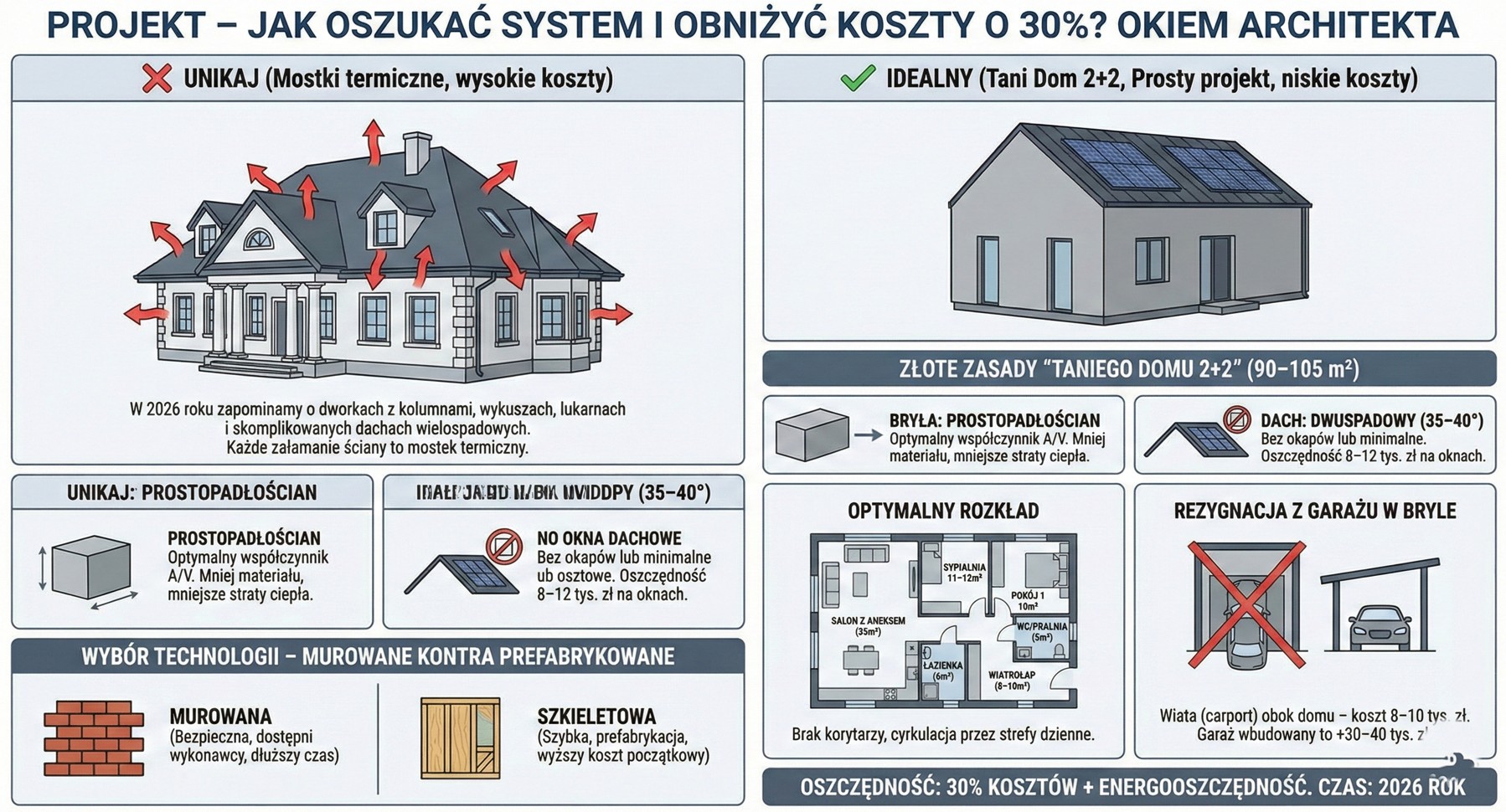
In 2026 we forget about manor houses with columns, bay windows, dormers and complex multi‑slope roofs. Every wall break, every recess, every balcony is a thermal bridge – a point through which heat escapes. It also means extra square meters of masonry, flashing and labor. A simple design is a cheap design.
Golden rules of the “2+2 Cheap House”
Form: cuboid. This is not a “modern barn” fashion, it’s pure construction economics. A cuboid has the most favourable A/V ratio (external partition area to volume). Example: a 100 sqm house on an L‑shaped plan has up to 15% more external wall area than a rectangle of the same floor area.
Roof: gable, without eaves (or minimal), pitch 35–40° – ideal for photovoltaics. Giving up roof windows saves PLN 8–12k. In summer you don’t overheat the attic.
Floor area: 90–105 sqm – perfectly sufficient if the design has no corridors. Here is the optimal layout: living room with kitchenette 35 sqm, parents' bedroom 11 sqm, children's rooms 2x10 sqm, bathroom 6 sqm, toilet/laundry 5 sqm.
No built‑in garage. An integrated garage costs an extra PLN 30–40k + heat losses. In 2026 we build a carport next to the house – expense PLN 8–10k.
Technology choice – masonry vs prefabricated
Masonry (AAC, sand‑lime bricks) – safe, widely available, forgiving. Ideal for drawdown mortgages. Prefabricated timber frame – move‑in after 3 months, higher initial cost, elimination of thermal bridges. The decision depends on your time horizon and available cash.
STAGE 3: Shell stage – foundations and walls
Builder Engineer Builder & Engineer perspective
There is no room for error here. What you cover with plaster and styrofoam will surface after 5 years as mould, cracks and heating bills.
Raft foundation vs footings – 2026 leaves no illusions
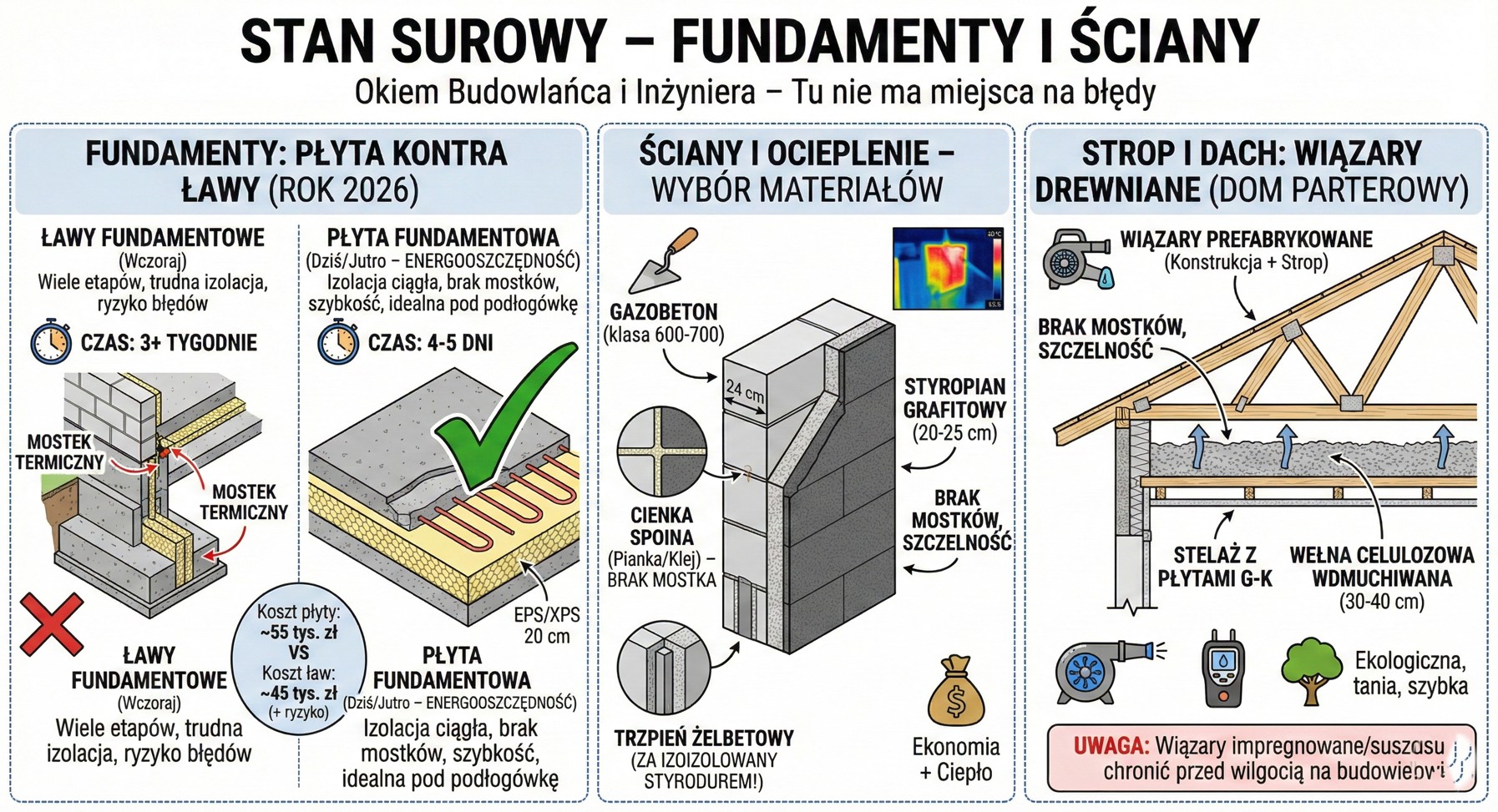
Only a raft foundation. Continuous insulation (20 cm EPS/XPS), execution speed (4–5 days), cost comparable to footings when all layers are included. The slab provides a perfectly flat surface for underfloor heating.
Walls and insulation
Recommendation: AAC 24 cm + graphite polystyrene 20–25 cm. Thin‑joint adhesive (PUR foam). Thick cement mortar is a thermal bridge! Insulate reinforced concrete cores from the outside with XPS.
Ceiling – timber roof trusses
For a single‑storey house with an unused attic: prefabricated roof trusses – roof and ceiling structure in one. Insulation: blown cellulose 30–40 cm (cost PLN 5–7k). The tightest and cheapest method.
STAGE 4: Windows and doors – installation matters more than the window
Builder Builder’s view
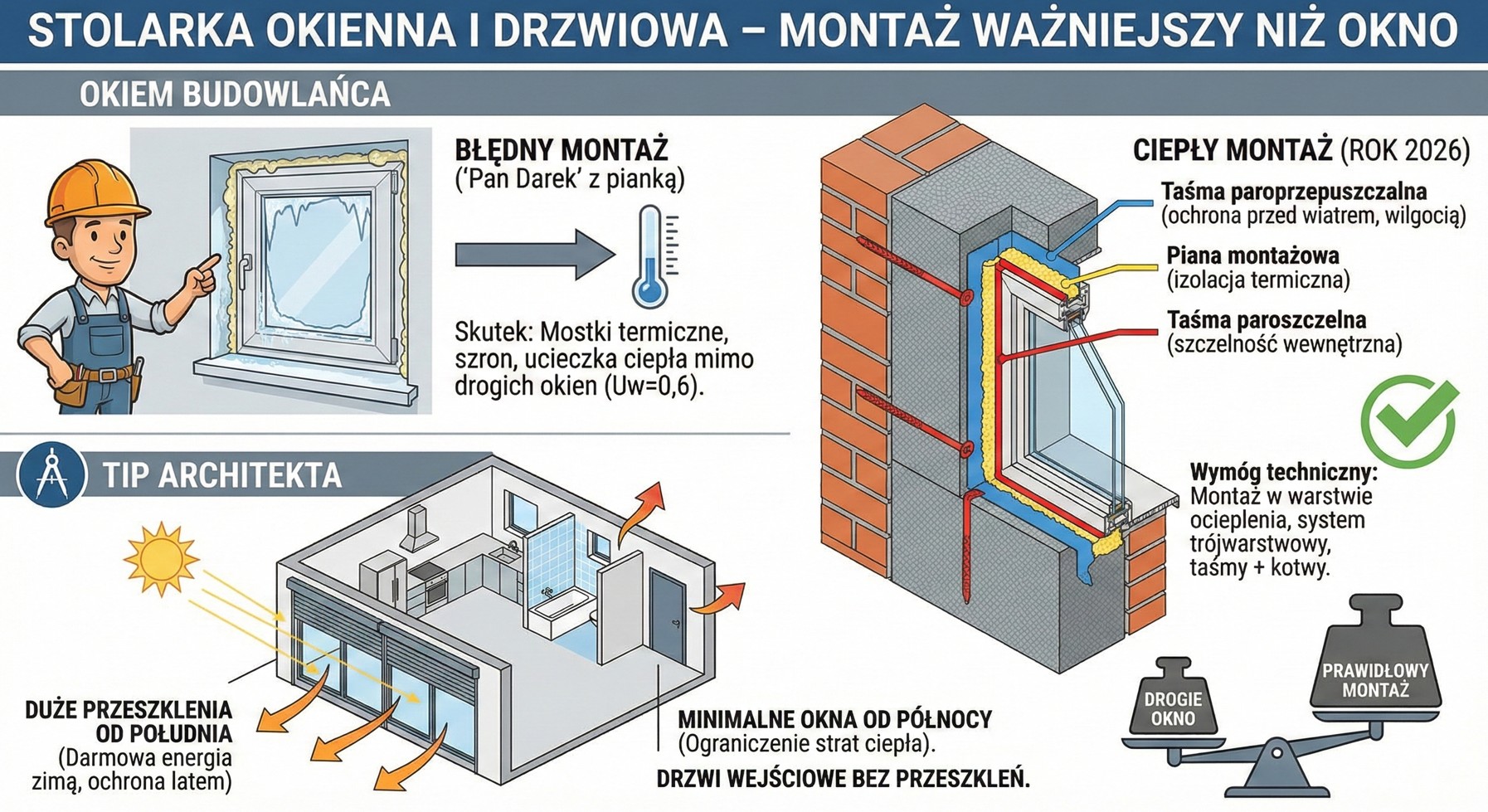
Many investors fall into the trap: they buy the most expensive windows (Uw=0.6), and entrust the installation to “Joe who always uses foam”. Result? Thermal bridges at the joints. Joinery is a system: window + installation. In 2026 the standard is thermal installation – window in the insulation layer, vapour‑tight and vapour‑permeable tapes, anchors through the insulation. Foam alone is not enough.
Architect’s tip: Large glazing only on the south side (free gains). North side – minimum. Entrance door without glazing.
STAGE 5: Installations – the heart of the house, or how to reduce bills by 70%
Energy expert Installer
Heating and cooling – end of fossil fuels
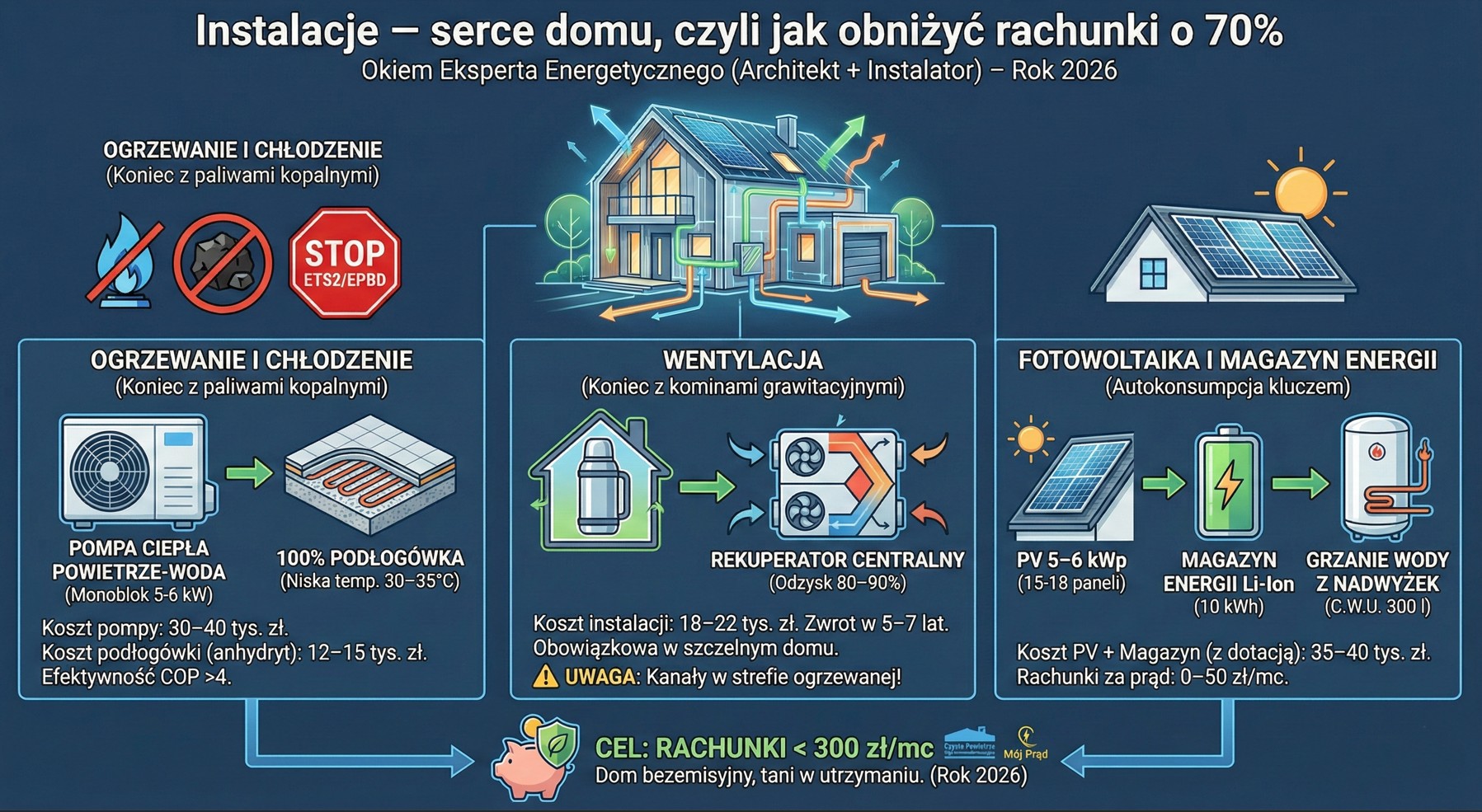
Forget gas. ETS2 from 2027, EPBD directive. Air‑to‑water heat pump with 5–6 kW capacity – cost PLN 30–40k. Heating: 100% underfloor heating (35°C supply) – anhydrite screed, comfort and high COP.
Ventilation – end of gravity chimneys
A tight house needs MVHR. Heat recovery ventilator with 80–90% efficiency – cost PLN 18–22k. Payback in 5–7 years. Without it, ventilation losses are 30–40%.
Photovoltaics and energy storage – self‑consumption is key
PV installation 5–6 kWp + 10 kWh energy storage (grants from "My Current 7.0/8.0"). System cost after subsidy: PLN 35–40k. Monthly electricity bill: PLN 0–50. DHW heating from summer surplus – free.
STAGE 6: Finishing works – where the lawyer meets the designer
Architect Lawyer
Contracts with contractors – protect yourself legally
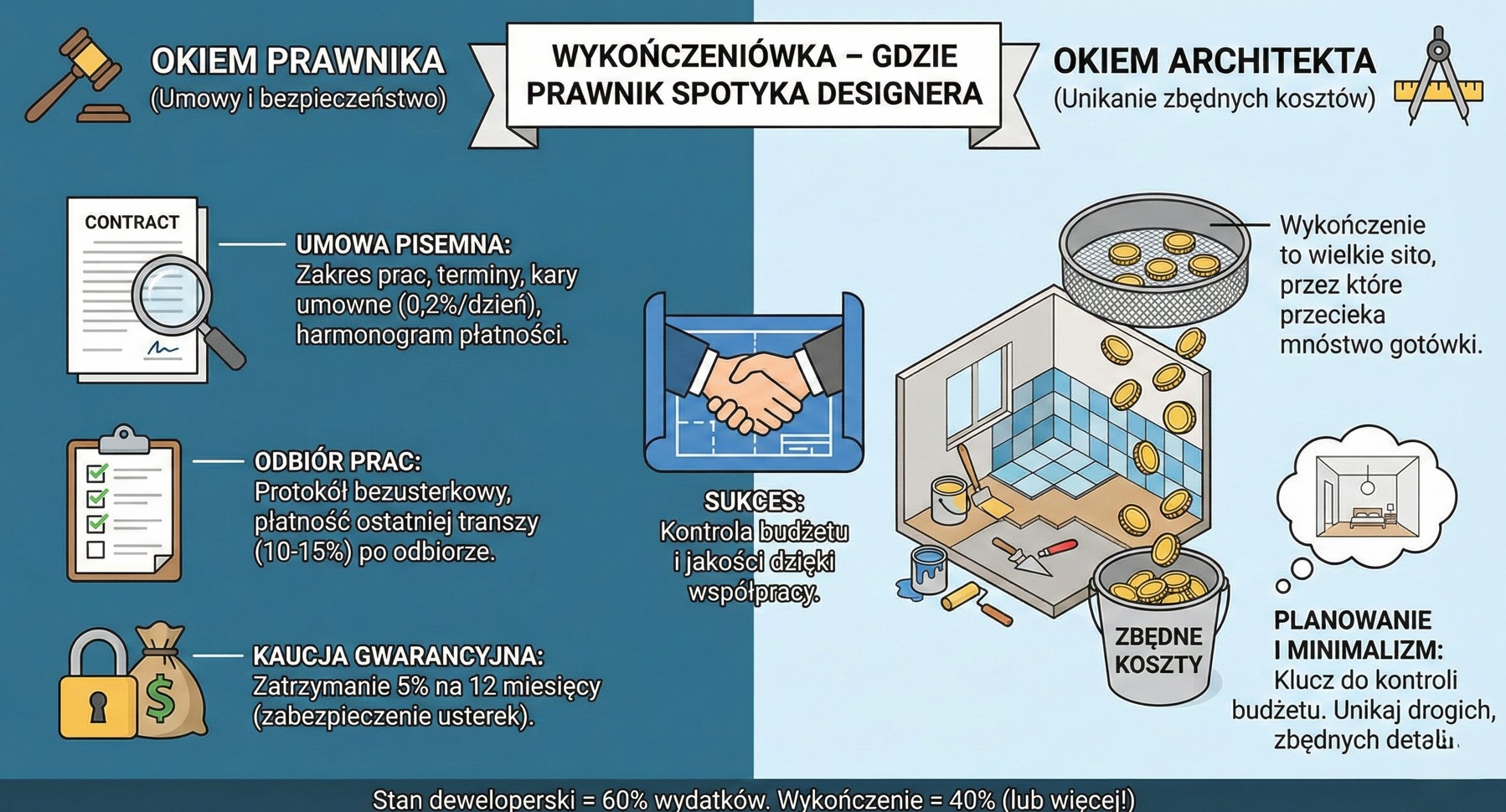
Never a “handshake deal”. Written contract: scope, contractual penalties for delay (0.2% per day), payment schedule. Work acceptance – final instalment only after a defect‑free protocol. 5% retention guarantee – hold for one year.
“Budget‑friendly” design – architectural tricks
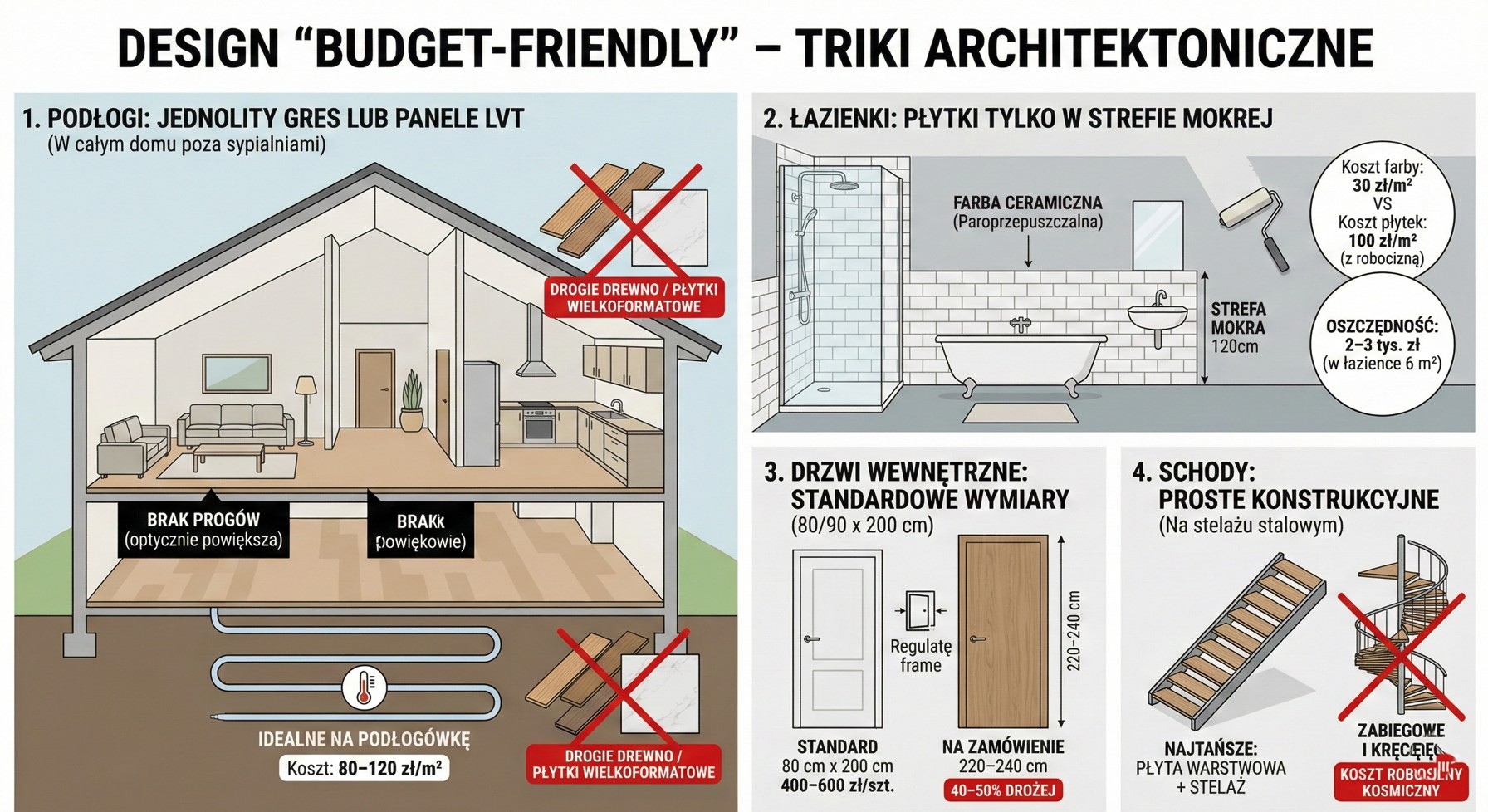
Floors: uniform gres or glued LVT vinyl panels – no thresholds, ideal for underfloor heating. Bathrooms: tiles only in wet zones (shower, bath, behind sink), rest painted with ceramic paint – saving PLN 2–3k. Internal doors: standard height 200 cm – 40% cheaper than custom‑made.
Cost summary – real picture of 2026
Builder Analyst Builder & Analyst perspective
Estimate for a 100 sqm house, energy‑efficient standard, Q1 2026, net prices (excl. VAT), contracted trades (not general contractor).
| Stage | Scope | Net cost (thousand PLN) |
|---|---|---|
| Zero stage | Raft foundation, utility connections | 50–60 |
| Open shell | Walls (AAC), trusses, roof, gutters | 140–160 |
| Closed shell | Windows, external doors, carport, cellulose insulation | 40–50 |
| Installations | Heat pump + underfloor heating, MVHR, electrics, plumbing | 90–110 |
| Internal finishing | Plasters, screeds, facade (20 cm EPS + render) | 70–90 |
TOTAL developer stage: PLN 390–470k net. Turnkey finishing (materials+labor in economical version) approx. PLN 1500–2000/sqm = PLN 150–200k. Total house: PLN 540–670k + plot PLN 150–250k. Total investment PLN 700–900k – still 30% cheaper than from a developer.
Final word – philosophy of the “Living Machine”
Journalist There will be moments of doubt – rain, delays, price hikes. Don't panic.
Lawyer Keep your papers in order. Offices don't forgive, neighbours love to complain. A binder is essential.
Builder Spirit level and straightedge – carry them always. Check verticals, trusses, continuous insulation.
Architect Don't build a castle. A 100 sqm home brings joy when it is warm, quiet and the bills are symbolic. It's worth it.
Don't build a castle. Build wisely. Good luck!